



Unless you’ve been caught up in the endless flurry of Trump’s twitter rants or been completely immersed in the mundane monotony of Love Island, you’d be aware that a topic coming under intense scrutiny in the media is the impact of Brexit on British economy.
The UK triggered Article 50 of the EU Lisbon Treaty on March 29, 2017, granting it the right to engineer a unilateral exit. As the two-year window to finalize the exit draws to a close, the real impacts on the economy are just being felt. (Schraer, 2019).
If you’re of a sporting persuasion, a more vocally debated topic is the effects on English football clubs, particularly those with foreign owners and a squad beefed up with international players.
Take Leicester City FC, for example. The club defied all odds to become the Premier League Champions in 2015-16, the first time in ages a relatively less-financially backed club had upset its richer competitors to lift the most coveted trophy in the country. (BBC, 2016)
But, with a no-deal Brexit looming threateningly in the horizon, the club are set to enter a period of potential turmoil and unpredictability.
Diminishing economic value
As the pound rate keeps falling against global markets, Leicester face a scenario of having to pay more whenever they purchase a footballer (asset) from a foreign club who operate with a different currency. (Mcmahon, 2016)
This undermines their ability to strengthen with talented acquisitions, leaving them unable to compete with richer clubs where Brexit’s financial repercussions will be on a relatively lesser scale due to already having a higher revenue and a wider global presence.
Foreign Involvement
Leicester City are one of myriad clubs who are owned by a foreign owner, having been taken over by Thai consortium Asia Football Investments in 2010 (BBC, 2010). With Brexit effectively devaluing UK-based businesses due to the dropping value of the pound, there are fears that owners might reduce investment in the clubs they own (McMahon, 2016)
This could potentially lead to a situation where Leicester have minimal access to their owner’s funds, leaving them unable to invest in new players, staff or infrastructure. This is the phase where an organization transitions from a star to a cash cow, due to the industry no longer experiencing market growth (Reeves, 2014)
The organization also have a lot of foreign players on their asset books, with as many as 19 in the current squad. Around 10 of these are European, showing the club’s tendency to leverage the benefit of free movement within the EU in order to craft a perfectly balanced squad. (Lcfc.com, 2019).
With Brexit, not only are the club facing a monumental task in procuring work permits for anyone signed from outside the UK, but also potential scenarios of foreign players demanding increased wages to counter the falling pound value. (McMahon, 2016)
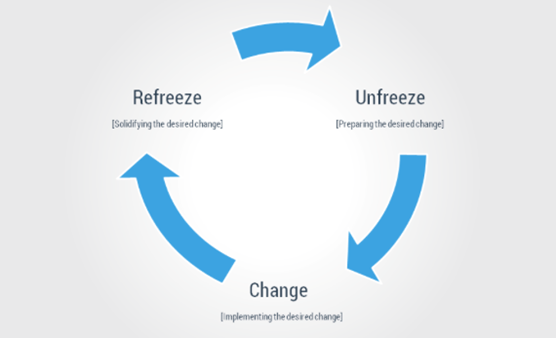
A short-term solution based on Lewin’s model is to convince the players to accept lower wages till the financial uncertainty clears. This temporary change can be achieved by open communication in order to impress upon them the need for change, while discussing renumeration options once the financial climate improves. Such an option for an incentivized future could make the change curve easier to ride out due to employee willingness to adapt to the ‘controlled crisis’ environment and accept the transition. (Schein, 1996)
Long-Term Solution
Leicester must rely on Kotter’s change model and empower their exceptional scouting network to unearth cheap talent around the globe. When Leicester defied all odds to win the premier league, they did so by spending most of their modest $82 million budget on putting together a remarkable scouting and data analytics team. (Henshall, 2016)
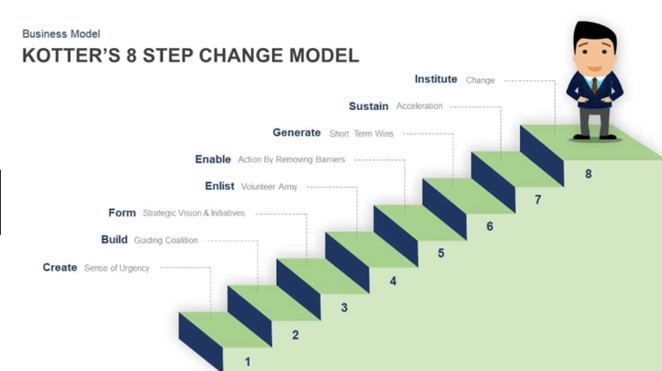
The club must revert to these methods to adapt to these troubled times and evolve from it, focussing on dedicated scouting and performance analysis to find the perfect asset to invest in. Furthermore, these assets can later be sold on for a massive profit, helping them double or triple their investment while remaining competitive and sustainable as a business.
The club can streamline this change process by establishing a sense of urgency ahead of the upcoming season, and re-allocating transfer funds to beef up their scouting and analytics teams. These teams must be entrusted with a clear vision in line with the club’s long-term strategy and empowered to make their own decisions. Short term mistakes in the form of transfer duds must be tolerated in order to emphasize on long-term returns.
The same structural changes must be extended to their academy personnel in order to unearth home-grown talent. This will help the organization adhere to the new rules brought about by Brexit as well as save millions of pounds in transfer fees.
Once these strategies are successful, they must be institutionalized in order to incorporate it into the club’s philosophy and ensure it survives the test of time against a revolving door of players, managers and owners.
References
BBC (2010). Leicester City takeover ratified by football league. BBC [Online]. Available at: http://news.bbc.co.uk/sport1/hi/football/teams/l/leicester_city/9118846.stm [Accessed July 6, 2019]
BBC (2016). Leicester win the premier league. BBC [Online]. Available at: https://www.bbc.co.uk/sport/football/35988673 [Accessed July 6, 2019]
Burke, W. W. (2017). Organization change: Theory and practice. Sage Publications [Online]. Available at: https://www.tandfonline.com/toc/rjcm20/current [Accessed July 6, 2019]
Henshall, A (2016). Four secrets to Leicester’s fairy-tale win. BBC [Online]. Available at: http://news.bbc.co.uk/sport1/hi/football/teams/l/leicester_city/9118846.stm [Accessed July 6, 2019]
LCFC (2019). Leicester first team. Lcfc.com [Online]. Available at: https://www.lcfc.com/teams/first-team [Accessed July 6, 2019]
McMahon, B (2016). 11 ways Brexit will impact the premier league. Forbes [Online]. Available at: https://www.forbes.com/sites/bobbymcmahon/2016/06/24/this-week-in-soccer-biz-special-11-ways-brexit-vote-will-impact-premier-league-and-soccer-worldwide/#56b358107d85 [Accessed July 6, 2019]
Reeves, M (2014). BCG: The growth share matrix. Bcg.com [Online]. Available at: https://www.bcg.com/publications/2014/growth-share-matrix-bcg-classics-revisited.aspx [Accessed July 6, 2019]
Schein, E. H. (1996). Kurt Lewin’s change theory in the field and in the classroom: Notes toward a model of managed learning. Systems practice, 9(1), 27-47. Available at: https://link.springer.com/article/10.1007/BF02173417 %5BAccessed July 6, 2019]
Schraer, R (2019). Can the UK revoke Brexit? BBC [Online] Available at: https://www.bbc.co.uk/news/uk-politics-47668466 [Accessed July 6, 2019]
Todnem, R. (2005). Organisational change management: A critical review. Journal of change management, 5(4), 369-380.
 Academia in Business
Yes, it is unrealistic to convince players to accept lower wages.
LikeLike
Absolutely. Do you think incentivising them with better rewards in the future will make the transition easier to accept?
LikeLike
Amazing! I really liked your blog. Models that you have used are appropriate and well structured.
LikeLike
Thanks, do you think the recommendations are feasible or too far fetched?
LikeLike
Don’t think a lot of players will or can be convinced to accept lower wages. Incentivising will also be subjected to the effects of this no-deal Brexit. Best approach will be scouting for and training the home-grown talent for now.
LikeLike
Exactly, do you think clubs would be willing to play the long game though?
LikeLike