



Before we delve into the topic, let’s start with a little premise – What exactly is ‘Organizational culture’? Since ‘culture’ is inherently an abstract, non-tangible entity, there have been several definitions for it over the years, each varying according to perception and perspective. Simply stated, organizational culture is “the way things are done around here” (Deal & Kennedy, 2000).
I personally interpret ‘doing things’ as how people within the organizational system behave and interact with internal and external forces, encompassing peers, superiors and clients. This is a holistic philosophy embedded and ingrained within an organization’s ranks.
Origin and Significance
Culture is usually identified and established by someone at the top of the organizational hierarchy, the ones with the authority and motivation to establish a practice or way of doing things. (Zenger, 2017)
Why is this important? Since values, thoughts and beliefs stem from an established culture, and actions and behaviour lead from these thoughts, the way people within an organization interact and do business is usually borrowed from each other and based off the main cultural identity or DNA. (Deal & Kennedy, 2000)
Effect on Business
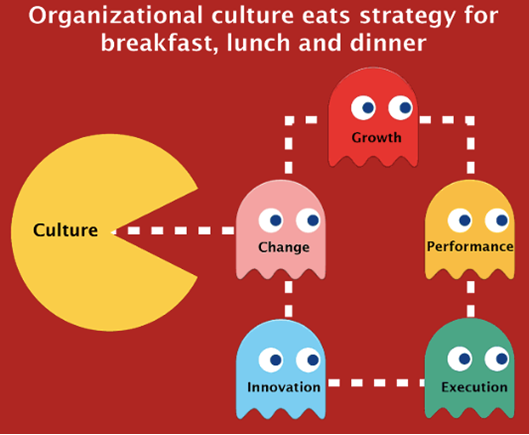
This makes culture more significant than strategy when it comes to how it affects success. Like Peter Drucker famously quipped, ‘Culture eats strategy for lunch’. (Zenger, 2017). Therefore, it’s inevitable that this very culture is questioned when things go downhill, leading to a situation where organizational values and principles need to be enhanced or even completely dismantled.
Take Uber, for instance. The company’s reputation has come under immense scrutiny in recent times, with myriad accusations of unethical behaviour levelled against the cab aggregator giants. This includes several lawsuits encompassing various accusations, ranging from passenger safety to stolen industry secrets (Bronner, 2017)
In such a scenario, how important is going back to the drawing board and uprooting a deeply entrenched culture in order to improve things?
Deep rooted problems
While Uber’s aggressive, survivalist strategy was successful in the fledgling days of a ‘winner take all’ market, its recent troubles can be pinned on a failure to adapt its culture to brand growth. (Bond, 2019). Uber is still suffering the repercussions of negligent hiring, with several sexual harassment lawsuits against its employees pointing out that the drivers in question had documented history of similar behaviour (Bronner, 2017).

Waymo, a self-driving tech pioneer, recently filed a detailed lawsuit against Uber stealing its trade secrets. (Bronner, 2017). Uber has also admitted to paying off hackers who stole data on 57 million driver and client accounts to the tune of $100,000 to keep the data breach confidential, a move that cost Uber’s security officer his job (Isaac, 2017)
It’s clear that Uber’s problems go way beyond scratching the surface, but how can the company go about a much-needed cathartic culture cleansing?
Change in leadership
A 2017 survey of 91 companies, each with a revenue greater than $1 Billion, found that people with more supportive managers were more likely to embark on organizational development, essentially ripping up the guidebook and starting afresh. (Zenger, 2017)
This highlights the need to focus on a culture change stemming from leadership, translating to a proportional change in values and action. This is especially true in Uber’s case where the problems are diverse, magnified and deep rooted.
CEO Dara Khosrowshahi seems to realize this, as he frequently highlights the need for a culture shift, evolving from an era of ‘grow at all costs’ to more responsible growth. In fact, he says, “Toe-stepping” was meant to encourage employees to share their ideas regardless of their seniority or position in the company, but it was used as an excuse for being an asshole”, highlighting the need for an ethical cleansing of sorts (Uber.com, 2017)
Recommendations – Charter Statement
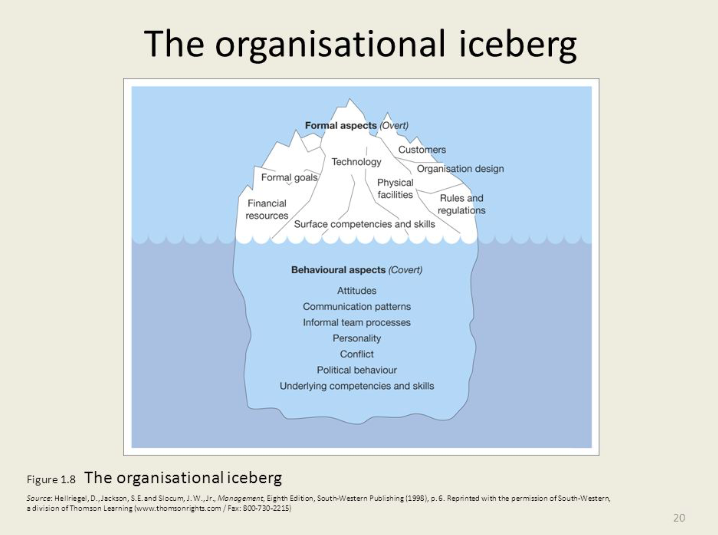
- Uber’s new CEO and top-level leaders should encourage self-empowerment from the bottom-up rather than top-down, encouraging employees to incentivize themselves in order to instil a holistic culture change. This will accelerate the process of identifying the covert or behavioural aspects of the organizational iceberg, the intangibles like attitudes, personality and communication patterns that breeds Uber’s existing ‘toe-stepping’ and ‘win at all costs’ mentality alluded to above. (Darling, 2003)
2. This could also be categorized as a gradual shift from a ‘role culture’, where an aggressive culture was perpetrated through hierarchical bureaucracy, into a ‘task culture’ where the power to decide how to interact and act rests on the employees according to the nature of their specific tasks. (Darling, 2003)
3. A specific area of change can be the attitude to uncertainty avoidance, a cultural dimension defined by Hofstede as ‘how much risk are people at the workplace ready to take?’. While Uber operates in a geo-culture that typically has low uncertainty avoidance and tends to take risks, maybe Uber should encourage and exercise a bit more caution, given its problems of negligent hiring, lawsuits and paying off hackers, all of which could be avoided with a measured approach aimed at eliminating risks. (Tanure et all, 2010)
References
Bronner, S (2017). ‘Revelations that Continue to Tarnish your Brand’. Entreprenuer.com.[Online].Available at: https://www.entrepreneur.com/article/305441 [Accessed July 2, 2019]
Bond, S (2019). ‘Uber Aims to Heavy Spending to Keep Up’. Financial Times. [Online]. Available at: https://www.ft.com/content/6d074560-5115-11e7-a1f2-db19572361bb [Accessed July 2, 2019]
Darling, J (2003), When Cultures Collide’, European Business Review, Vol 15 No 5, pp. 312-323 [Accessed July 3, 2019]
Hellriegel, D., Jackson, S.E. and Slocum, J. W., Jr., Management, Eighth Edition, South-Western Publishing (1998), p. 6. [Accessed July 3, 2019]
Isaac, M (2017). ‘Uber Hid 2016 Breach’. New York Times [Online]. Available at: https://www.nytimes.com/2017/11/21/technology/uber-hack.html?_r=0 [Accessed July 2, 2019]
Tanure, B. (2010). ‘Comparing Regional Cultures Within a Country: Lessons from Brazil. Journal of Cross-Cultural Psychology’, 41(3), pp.336-352. [Accessed July 3, 2019]
Uber.com (2017). ‘Uber’s New Cultural Norms. Uber [Online]. Available at: https://www.uber.com/newsroom/ubers-new-cultural-norms/ [Accessed July 2, 2019]
Zenger, J (2017). ‘Change your Leaders to change your Culture’. Forbes [Online]. Available at: https://www.forbes.com/sites/jackzenger/2017/11/25/change-your-leaders-to-change-your-culture/#5404897c67d5 [Accessed July 2, 2019]
 Academia in Business
Great post 🙂
LikeLike
Thanks, do you agree with the sentiment of the post?
LikeLike
Informative content
LikeLiked by 1 person
Thanks..Any bit you found particularly informative?
LikeLike
Good research
LikeLike
Thank you. What do you make of the recommendations for uber?
LikeLike
My brother is a Uber driver and he likes the recommendations. I agree with your points, Uber could defeinitely benefit from such a cultural change as what you suggested.
LikeLiked by 1 person
Wow that’s an incredible co-incidence..yeah a culture prioritising every employee it the way forward
LikeLike
Great research .
LikeLike
Cheers, do you think the suggestions are feasible to contemporary workplaces?
LikeLike
Great application of the theories to Uber. The Charter statement also provides a clear guideline for the company
LikeLike
Thanks, do you think Khosrowshahi is the right man to turn the company’s reputation around?
LikeLike
Interesting POV. Good write up.
LikeLike
Thanks man, do you think the suggested recommendations are relevant or far fetched?
LikeLike
Could you elaborate on task culture?
LikeLike
It basically refers to the ‘task’ taking precedence, and power or leadership drifting to the person most suitable to lead within the context of that project
LikeLike